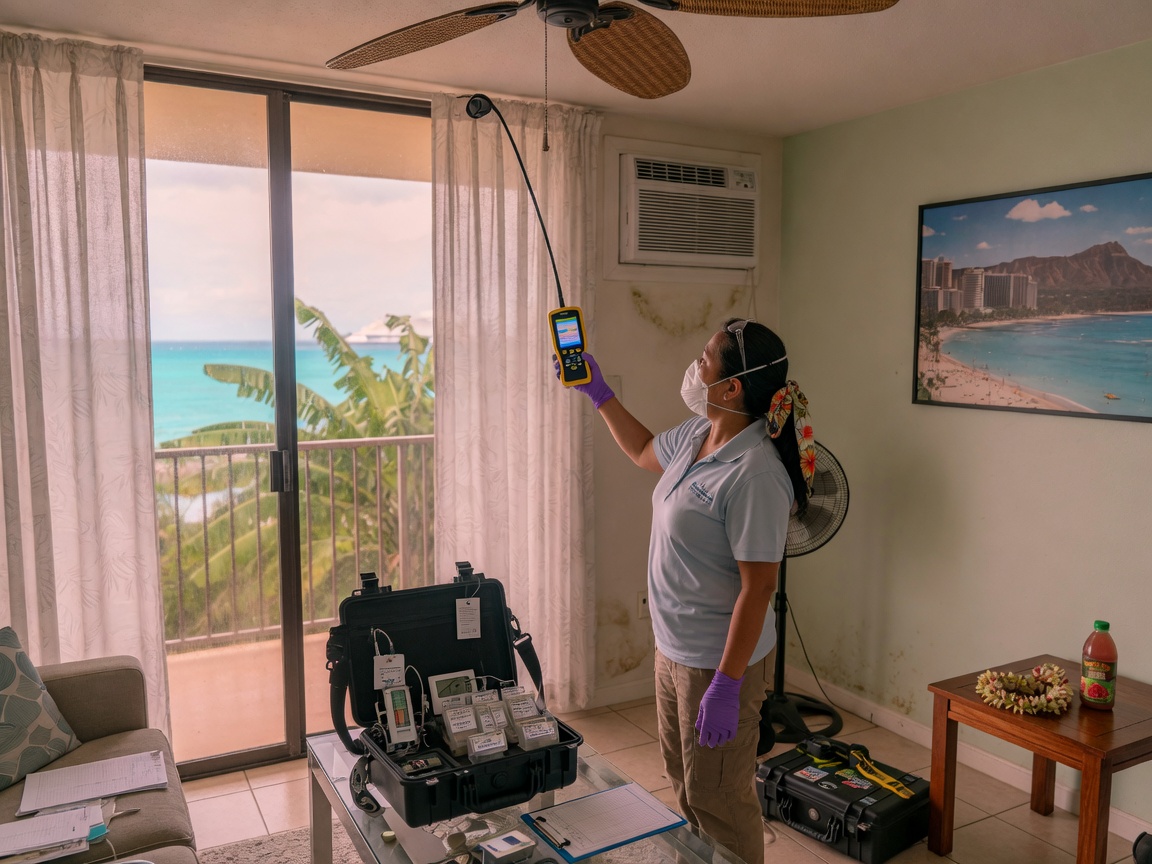
Honolulu's tropical climate brings consistent warmth and trade winds that push moisture through older single-wall homes in Nuuanu, Manoa and Alewa Heights. These conditions allow mold to grow in wall cavities and ceiling spaces that rarely dry out completely. Testing must account for salt-laden air near Waikiki Beach and Pearl Harbor that corrodes HVAC components faster than inland spots like Palolo or Kaimuki.
We sample for mold spores, volatile organic compounds from older building materials, and excess humidity that trade winds fail to remove from tightly sealed Kakaako condos. Downtown Honolulu high-rises and Kalihi duplexes often show elevated readings near bathrooms and laundry areas where ventilation was never upgraded. Results guide precise filter upgrades or duct sealing instead of blanket equipment replacement.
Testing follows protocols that note how dry-season dust from nearby Aiea and Pearl City mixes with indoor humidity to create allergen loads different from mainland homes. We check crawl spaces common in Moiliili bungalows and attic insulation in Iolani Palace-area historic properties where airflow patterns trap contaminants.
Homeowners in Kailua and Pearl City frequently request repeat testing after heavy rains because trade winds shift and push moisture deeper into structures. Reports include location-specific recommendations that match Honolulu County building practices rather than generic national guidelines.
Technician insight
In Honolulu the thing that catches most people out with Indoor Air Quality Testing is assuming trade winds will dry everything out. Older single-wall homes in Manoa and Nuuanu trap moisture behind walls even during the dry season, so we always pull samples from those hidden cavities rather than just living areas.
Mold in Nuuanu Bungalow After Dry Season
A homeowner in Nuuanu noticed musty smells despite open windows. We found elevated mold spores in the attic where trade winds had pushed humid air under the roof deck. Targeted sampling and simple ventilation adjustments cleared the readings without full system replacement.
Indoor Air Quality Testing Services We Offer
✓Mold Spore Testing
Air and surface sampling in humid Honolulu neighborhoods to locate hidden mold growth triggered by trade-wind moisture.
✓Humidity and Moisture Mapping
Detailed readings across living spaces, attics and crawl spaces to find areas where dry-season conditions still allow condensation.
✓VOC and Chemical Screening
Detection of off-gassing from older construction materials common in Nuuanu and Manoa homes built before modern ventilation standards.
✓Allergen and Dust Testing
Measurement of pollen, dust mites and outdoor particles carried inside by trade winds near Waikiki and Diamond Head.
✓Post-Repair Air Verification
Follow-up testing after AC repairs or duct work in Kakaako and Downtown Honolulu to confirm contaminant levels have dropped.
Indoor Air Quality Testing Cost in Honolulu, HI
| Service | Typical Range | What Affects It |
|---|---|---|
| Basic IAQ Test (3 samples) | $275–$375 | Single-story homes in Kaimuki or Palolo |
| Standard IAQ Test (5–6 samples) | $450–$650 | Two-story homes or condos in Kakaako |
| Mold-Focused Add-On | $150–$225 | Extra surface swabs after water intrusion |
| Post-Repair Verification | $200–$300 | Retest after AC or duct work |
Ranges are typical for Honolulu, HI and confirmed with an exact written quote before any work starts.
How it works
- 1
Initial Consultation
Discuss symptoms and home history for properties in Waikiki, Manoa or Kaimuki.
- 2
On-Site Sampling
Collect air and surface samples from multiple zones while noting local humidity patterns.
- 3
Lab Analysis
Send samples for identification of mold, VOCs and allergens specific to Honolulu conditions.
- 4
Report And Recommendations
Deliver findings with targeted fixes matched to the home's age and neighborhood.
Pricing
Pricing depends on number of samples, home size and whether follow-up verification is needed.