
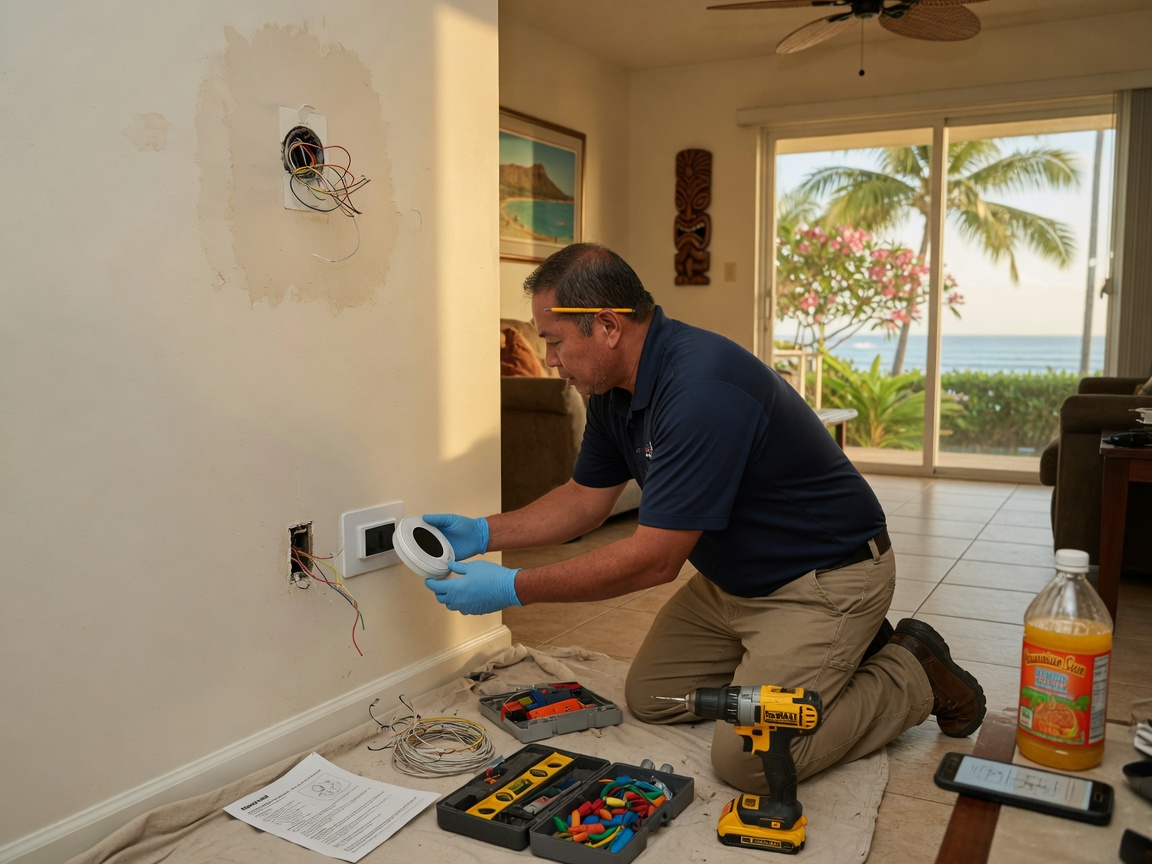
Honolulu homes built before 1980 in neighborhoods such as Nuuanu, Kaimuki and Alewa Heights often carry older low-voltage wiring that needs careful tracing before any smart thermostat can be mounted. Salt-laden trade winds accelerate corrosion on exposed terminals, so we use marine-grade connectors and dielectric grease on every connection. In the dry season the reduced moisture actually helps testing, yet the constant 80-plus degree temperatures mean the new thermostat must handle continuous compressor calls without overheating its own circuitry.
Central AC units serving Waikiki condos and Kakaako townhomes frequently run on 24-volt systems tied to older air handlers located in tight closets or rooftop platforms. Adding a smart thermostat here requires verifying that the C-wire is present or installing a compatible power extender kit so the device never drops offline during peak afternoon loads. We also confirm that the thermostat location avoids direct sun from Diamond Head-facing windows, which can trick the sensor into over-cooling the space.
Pearl City and Aiea homes with slab-on-grade construction present different challenges: condensate lines run under the slab and any new wiring must stay above grade to avoid moisture wicking. We route low-voltage cable through existing chases or surface-mount raceway when fishing is impractical, then label every conductor at both ends so future service calls stay simple.
Compliance with Honolulu County electrical standards means we never bypass the disconnect at the air handler and always leave the original thermostat wiring intact as a backup. After programming, we walk the homeowner through the app settings while standing in the same room so they can see how the device responds to the actual temperature swings caused by open lanai doors.
Technician insight
In Honolulu the thing that catches most people out with Smart Thermostat Installation is the combination of high humidity and older low-voltage wiring in 1950s–1970s concrete homes in Kaimuki and Palolo. Salt air corrodes terminals fast, and many of those houses still run the original cloth-insulated thermostat wire that cracks when you move it. We always carry marine connectors and test every run before we close the wall plate.
Kakaako Loft with Intermittent Power Loss
The homeowner reported the smart thermostat resetting daily. We found the original wiring lacked a C-wire and was routed through a damp chase near the condensate line. We added a power extender kit, replaced the corroded terminals with marine connectors, and relocated the device away from the west-facing window. The thermostat has stayed online through the subsequent trade-wind storms.
Smart Thermostat Installation Services We Offer
✓WiFi Thermostat Installation in Pre-1980 Homes
Trace and upgrade knob-and-tube or cloth wiring common in Manoa and Nuuanu before mounting the new thermostat.
✓C-Wire Adapter Installation
Add a power extender kit so smart thermostats work reliably in homes without a spare common wire.
✓Smart Thermostat Integration with Central AC
Connect the new control to existing air handlers serving Waikiki high-rises and Kakaako lofts without altering factory wiring.
✓Outdoor Sensor Placement for Trade-Wind Homes
Position remote sensors away from salt spray and afternoon sun to maintain accurate readings in coastal neighborhoods.
✓Multi-Zone Smart Thermostat Setup
Configure separate schedules for upstairs and downstairs units typical in Kalihi and Palolo split-level houses.
Smart Thermostat Installation Cost in Honolulu, HI
| Service | Typical Range | What Affects It |
|---|---|---|
| Basic Smart Thermostat Installation | $180–$320 | Standard 24-volt systems with accessible wiring in single-family homes |
| C-Wire Adapter Add-On | $75–$125 | Required when no common wire exists |
| Multi-Zone Configuration | $250–$450 | Two or more thermostats linked to separate air handlers |
| Sensor Placement in Coastal Homes | $95–$160 | Remote sensor for salt-air or sun-exposed locations |
Ranges are typical for Honolulu, HI and confirmed with an exact written quote before any work starts.
How it works
- 1
Site Assessment
Inspect existing thermostat wiring, air-handler location and internet signal strength at the property in your Honolulu neighborhood.
- 2
Wiring Verification
Confirm 24-volt power and run a C-wire adapter if needed, labeling every conductor for future service.
- 3
Mount and Connect
Install the base, attach the new thermostat and test communication with the AC system before leaving.
- 4
Programming and Handover
Set schedules, link the mobile app and demonstrate operation while standing in the conditioned space.
Pricing
Upfront quotes after we see your existing wiring and thermostat location.